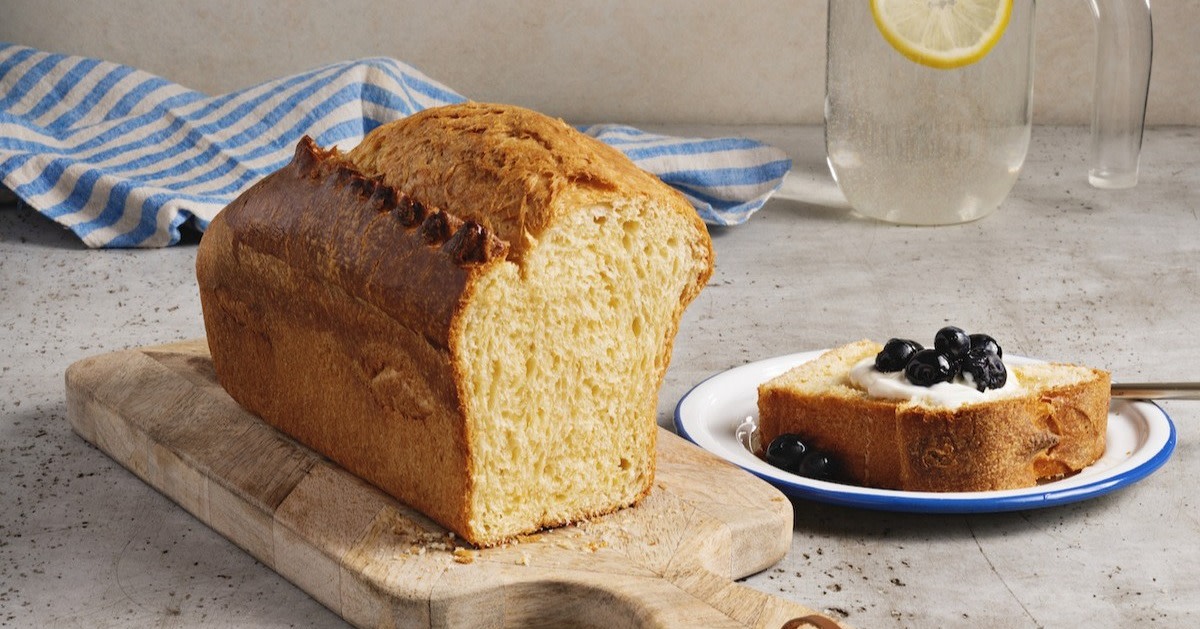
Apollonia Poilâne’s Classic French Brioche
Bread
Ingredients
1 package (2 ½ teaspoons or 7 grams) active dry yeast
2 tablespoons lukewarm (not hot) water
250 grams (2 ¼ sticks or 9 ounces) unsalted butter with a high-fat content, room temperature, cut into bite-size pieces (if your kitchen is very hot, compensate by using cool butter), plus more for buttering bowls and pans
500 grams (3 ⅔ cups) all-purpose flour, plus more for work surfaces
55 grams (¼ cup) sugar
7 ½ grams (1 ¼ teaspoon) fine sea salt
5 large eggs, room temperature, cracked into a medium bowl, plus 1 egg for egg wash
Directions
Activate the yeast. In a small bowl, use a fork to whisk the yeast with 2 tablespoons of lukewarm (not hot) water. Let sit until bubbly, about 2 minutes. After 2 minutes, give the yeast mixture a quick whisk with the fork. If it’s foamy, the yeast has activated. If not, start again with a new batch of yeast and lukewarm water.
Using a brush or a paper towel dipped in room temperature butter, generously grease 2 large glass bowls. Set aside.
In the bowl of a stand mixer fitted with the paddle attachment, combine flour, sugar, salt, and activated yeast. Add the activated yeast mixture to one side of the bowl and cover with a little flour to prevent the yeast from touching the salt.
Mix on low speed until ingredients are fully blended and consistency is uniform, about 30 seconds. Use a rubber spatula to scrape down the sides of the bowl.
Add 5 eggs and mix on low to medium speed until all of the ingredients are almost fully incorporated and the dough comes together, no more than 3 to 4 minutes. When the stand mixer starts struggling to mix the dough, it’s time to add the butter.
Remove the paddle attachment and attach the dough hook.
With the mixer on low speed, incorporate the butter in three to four additions, adding each addition only after the butter from the previous addition has mostly disappeared into the dough. Use a rubber spatula to bring the dough together, if necessary. Avoid overworking the dough, which will cause the butter to separate and become oily. Continue mixing on low to medium speed until the dough is smooth and shiny and pulls away from the sides of the bowl, 10 to 12 minutes. The dough shouldn’t stick to your hands, and it should have some resistance to the touch.
Lightly flour the work surface and transfer the dough to the work surface using a rubber spatula or bench scraper. Divide the dough in half using a bench scraper. Lightly flour your hands and gently shape dough into 2 ball-like shapes by lightly tossing the dough around the work surface and into your free hand using the bench scraper.
Gently cradle the dough into the greased bowls. Cover each bowl with a clean kitchen towel and let rest in a draft-free place at room temperature (68° Fahrenheit to 77° Fahrenheit or 20° Celsius to 25° Celsius). Let the dough rise until it has doubled in size, about 2 hours (but no more than 2 ½ hours). The dough should be yellowish in color, with a smooth top and some resistance.
Using a brush or a paper towel dipped in room temperature butter, generously grease two 9 x 5–inch loaf pans. Set aside.
Lightly flour your work surface and hands. Using your hands, a rubber spatula, or a bench scraper, delicately transfer the dough to the floured work surface.
Shape one of the dough balls. Working your way horizontally across the dough, gently push down with the heel of one hand to flatten the dough into an oblong shape that is the same length as the loaf pan (9 inches), with the long edge facing you. Use your free hand to gently cradle the dough, keeping it in position as your other hand flattens with the heel.
Fold the short edges of the dough in toward the dough’s center, just enough so that the edges become straight rather than rounded, about ½ inch on either side. Use your fingers to lightly press on the seams, re-expanding the dough to the length of the pan.
Place your palms flat on the work surface with your index fingers touching the far edge of the dough and your thumbs pointing back toward yourself. Gently roll the dough toward your body and shape it into a log, using your thumbs to tuck in the edges.
Carefully lift the dough log, cradling the heavier middle, and transfer it to the prepared pan, seam side down. Repeat the shaping process with the other dough ball.
Cover both pans with a clean cloth and leave them in a draft-free place, ideally your work surface, to avoid any unnecessary movement that can damage the dough. (If your kitchen is drafty, cover the pans with a plastic bag.) Let the loaves rise until the dough reaches the top of the pan or just above, about 1 ½ to 2 ½ hours. Try not to remove the cloth when checking on your dough, which will introduce a draft. Instead, notice if the cloth has risen.
When the dough has mostly risen, position a rack in the lower third of the oven and preheat the oven to 350° Fahrenheit or 180° Celsius.
Make the egg wash. In a small bowl, beat the remaining egg. Using a pastry brush, very delicately brush a small amount of egg wash over the top of each loaf, being careful not to oversaturate the dough, which can deflate the loaf or burn the top of the bread during baking.
Use clean kitchen scissors to score the center of the loaf. Set your free hand on the rim of the pan and use it as a ledge for the scissors. Guide your hand horizontally across the loaf as you make short snips along the length of the bread. Let the dough rise on the work surface, uncovered, for about 3 to 5 minutes, so that the dough can expand around the scoring marks. If the dough has over-proofed, skip this step and bake your loaf without scoring.
Bake until the loaves have expanded and are light terra-cotta/gold/orange in color, about 35 to 40 minutes. Don’t open the oven door during baking, which can cause the bread to collapse.
Leave the brioche in the pan until the surface of the bread is just cool enough to touch, about 2 minutes. Use one hand to cradle the bread and delicately turn it over to unmold. Place the loaf on a wire rack to cool, at least 1 hour.
Wrap the bread in a cloth and place it in a paper bag. Store at room temperature in a dry place for 5 to 7 days. If freezing, wait until the bread has cooled down entirely. Store it in a freezer bag for up to 3 months. Thaw the loaf at room temperature when you’re ready to use.